Market Metrics in Property Empire
Read yield, appreciation, schools, crime, and growth so every buy matches your weekly plan.
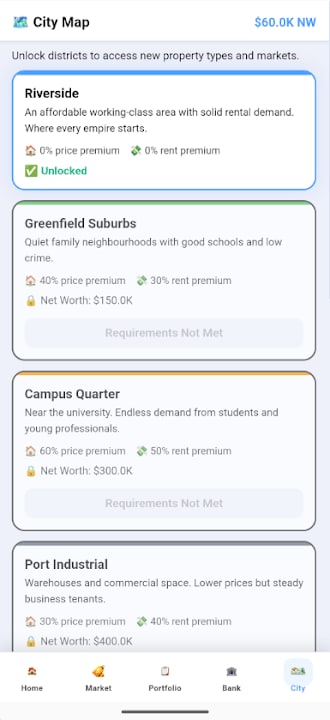
Market metrics are how Property Empire tells you what a listing is actually for. Price alone lies: a cheap Port Industrial shell with ugly crime and weak growth can destroy Stress for months, while a slightly dearer Greenfield Suburbs home with strong school ratings can fund a calm buy-and-hold. This guide covers rental yield, appreciation, school ratings, crime, and growth—how to read them on listings, how districts skew the mix, and what to do when two metrics disagree.
The game is Gaige’s Android weekly property tycoon (free with ads, Full Game v1.0 launched June 8, 2026). Single-player only: your reading of the numbers is the whole underwriting team. For the map itself, keep Districts & City Map open beside this page. For strategy forks after you understand metrics, see Buy-Hold vs Flip and the Guides Hub.
The five metrics that matter
Rental yield estimates income power relative to price and upkeep reality. High yield favors hold strategies and mortgage coverage. Use it with Rental Yield before you treat a brochure rent as guaranteed cash. Yield collapses if Happiness fails or vacancies linger—metrics assume you can operate the building.
Appreciation estimates value growth and resale upside. High appreciation favors flips after you cure Poor or Neglected conditions, and it rewards patience on holds you might sell later. Appreciation without a renovation budget is a mirage: buyers pay for finished stories, not hope.
School ratings matter most where families cluster. Strong schools support rent ceilings and longer tenancies in Greenfield Suburbs; they matter less for pure Campus Quarter student churn or Port Industrial commercial plays. Ignoring schools on a family listing is how you overpay for a unit that cannot clear the rent you modeled.
Crime is a risk and Stress signal. Elevated crime can pressure Happiness, raise vacancy odds, and make management weeks feel heavier even when headline yield looks attractive. Port Industrial often forces this tradeoff; Riverside can show pockets too. Price discounts that exist only because crime is ignored are not free money.
Growth captures broader district momentum—development, demand trajectory, and the sense that today’s price is not the ceiling. Growth supports both longer holds and timed flips. Weak growth means you must earn returns from operations (yield) rather than waiting for the map to bail you out.
How to read listing tooltips
When a listing shows metric badges or tooltips, translate them into a one-line thesis:
- “High yield, modest appreciation” → hold candidate if Energy can keep Happiness stable.
- “High appreciation, weak yield” → flip or short hybrid after targeted renovations.
- “Strong schools, fair yield” → Greenfield-style family hold; budget condition carefully.
- “High growth, elevated crime” → only with cash buffer and Stress headroom.
- “Poor/Neglected + strong appreciation” → classic value-add if repair Energy fits this week and next.
Always pair the tooltip with condition labels. Poor and Neglected are not cosmetic flavor; they are cost and Energy line items. A top growth score on a Neglected shell still needs the cure path from Flip & Renovate before metrics become real.
Cross-check relative quality with Best Properties and Best Districts so you are not grading a listing only against itself.
District differences
Riverside — Working-class classroom. Yields are approachable, prices forgive mistakes, and metrics teach the UI. Use Riverside to learn which tooltip patterns match your play style before Greenfield prices punish bad reads.
Greenfield Suburbs — School ratings and family demand dominate. Appreciation can be solid; crime is often calmer than industrial zones. Yield must still clear any mortgage—pretty schools do not pay the bank.
Campus Quarter — Demand and turnover define the story. Yield can look strong when units are full; growth and seasonal emptiness can interrupt it. School ratings are less central than in Greenfield; Happiness and Energy for rapid turns matter more.
Port Industrial — Commercial and industrial logic: growth and yield tempt big moves; crime and different tenant expectations raise Stress. Appreciation plays exist, but underwrite operations honestly. Do not unlock Port Industrial just because one growth badge looks exciting.
When metrics conflict
Conflicts are normal. Resolve them with your weekly goal, not with vibes.
- Yield vs appreciation: If Stress and mortgage coverage are tight, prefer yield. If cash is thick and Energy is free for a renovation sprint, prefer appreciation and flip.
- Schools vs yield: A slightly lower yield with sticky family tenants can beat a higher yield that churns every term—especially in Greenfield.
- Growth vs crime: Take growth only if you can fund Happiness buffers and recovery weeks. Otherwise the growth story becomes a Stress story.
- Condition vs every metric: Distressed stock can win on price-to-metric ratios after repairs. If Energy cannot finish the cure before debt service hurts, walk away.
Write the conflict down as a sentence: “I am accepting lower yield for schools because I need stable renewals while I climb ranks.” If you cannot finish the sentence, skip the buy.
Underwriting checklist before you bid
- Note the five metrics and the condition label.
- Estimate Energy weeks to rentable or saleable.
- Run a yield sanity check with Rental Yield.
- Decide hold, flip, or hybrid using Buy-Hold vs Flip.
- Confirm the district still matches your Stress and reputation stage via Districts & City Map.
- Only then open leverage conversations from the mortgages guide.
Metrics and the weekly loop
Metrics do not spend Energy—you do. A perfect appreciation score is worthless if renovating it empties the bar while a mortgaged Riverside rental goes vacant. Re-read Happiness, Stress, and Energy habits whenever a “great metrics” deal starts dictating frantic weeks.
Likewise, ranks from Small Landlord toward citywide tycoon favor landlords who buy what they can operate. Chasing every high-growth badge across four districts is how portfolios look impressive and feel insolvent.
Practical examples (pattern language)
- Riverside Poor unit, solid yield, flat appreciation → renovate to rentable, hold, learn tenant UI.
- Greenfield fair condition, strong schools, mid yield → hold; avoid flipping just because suburbs feel premium.
- Campus high yield tooltip mid-term → model a vacant tick; keep cash buffer.
- Port Industrial high growth, high crime, Neglected → only with spare Stress capacity and a clear commercial thesis.
Wiki paths to keep open
No verified promo codes or fan videos change how tooltips work—your eyes on yield, appreciation, schools, crime, and growth do. Read the listing, name the thesis, fund the Energy, and let metrics serve the week you are actually playing.
Frequently Asked Questions
Quick answers to the most common questions.
Which metric matters most for beginners?
Rental yield plus condition. Early Riverside survival depends on covering costs and learning operations before chasing appreciation headlines.
When should I prioritize appreciation over yield?
When you have cash and Energy for a clean renovation and a planned sale—not when a mortgage needs reliable rent this week.
Do school ratings matter outside Greenfield Suburbs?
They matter most for family holds in Greenfield. Campus and Port Industrial decisions usually hinge more on demand, turnover, crime, and growth.
How should I treat high crime on an otherwise strong listing?
Demand a thicker cash and Stress buffer, plan Happiness maintenance, or pass. A yield discount that ignores crime often costs more later.
Where do I compare districts after reading metrics?
Use Districts & City Map plus the Best Districts and Best Properties tier lists, then confirm strategy on Buy-Hold vs Flip.